
The array of attachments available for skid steers and track loaders make them good tools for landscapers. The benefits for the landscaper make it easy to see why they are so prevalent in the landscape business. There’s a wide attachment selection, and a broad range of tasks can be performed easily just by changing between attachments. They are also compact enough to operate in smaller spaces, and they move from jobsite to jobsite fairly quickly.
If you google “when was the skid steer invented?†various sources will tell you that the first skid steer prototype was an odd-looking three-wheeled loader. If you dig deeper, you will learn that the first skid steer was invented in 1957 by brothers Louis and Cyril Keller in Rothsay, Minn. The brothers were the owners of Keller Mfg., a small fabricating and general repair business. Their main business was a single-stage snowblower, but in 1956 a local turkey farmer approached the brothers to build a machine to clean out turkey barns. Tractors of the day were not maneuverable enough and were too heavy for the second story. By 1957, the first skid steer was being tested and it exceeded expectations.
Today, skid steers and their track loader counterparts still have a place on the farm but have moved into the city too. You are just as likely to see skid steers and track loaders in construction, material handling or landscaping applications. Attachments have grown beyond buckets too. Farmers will use bale grabbers to move and stack hay or manure grapples for clearing stalls in a barn. Construction-minded users know the power that can be unleashed in a hammer for breaking concrete. Once crushed, the concrete and debris can be moved with a scrap grapple bucket. Heavy-duty brush cutters can tackle trees to aid in land clearing for utilities or reclamation projects. Trenching, snow removal and site leveling are a few more of the many tasks that skid steer and track loader attachments will help you get done.
The array of attachments available for skid steers and track loaders make them good tools for landscapers. The benefits for the landscaper make it easy to see why they are so prevalent in the landscape business. There’s a wide attachment selection, and a broad range of tasks can be performed easily just by changing between attachments. They are also compact enough to operate in smaller spaces, and they move from jobsite to jobsite fairly quickly. Tools in a landscaper’s arsenal can range from seeders and trenchers to powered rakes and tillers, all from one power unit. Skid steers can even use smart attachments for precision site leveling on sports fields or in areas where a precise grade is a must. Let’s take a closer look at some of these landscape attachments.
Trenchers
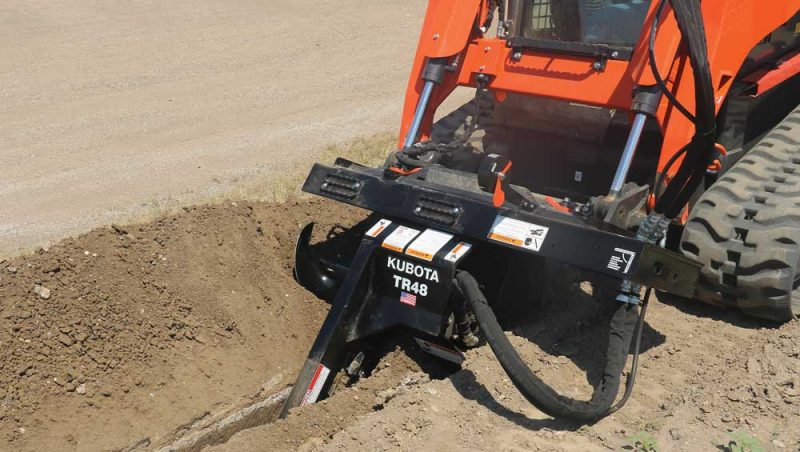
Skid steer- or track loader-mounted trenchers have uses across various industries. From installing buried fiber-optic cables for a new development to installing an irrigation system at a sports complex, trenchers efficiently slice a narrow trench in the soil, leaving the spoil next to the trench for efficient backfill. Trenchers use a variety of chains depending on the soil type — rock, sand, clay or loam — and it is important to match the chain to the digging conditions. Widths can vary too, depending on the application, from a modest width of 4 to 12 in.
Tillers
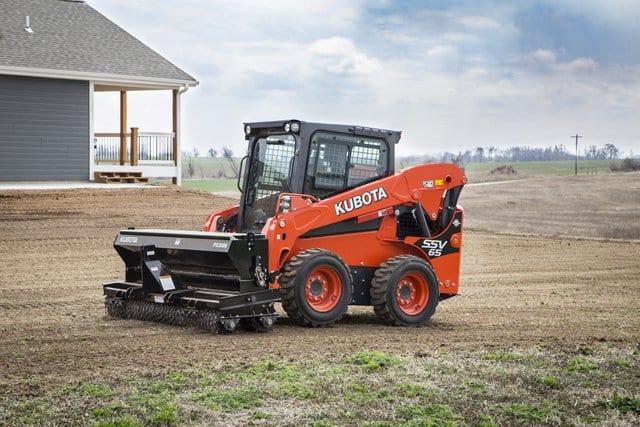
Garden tillers have been around since the 1930s. The skid steer/track loader tiller expands on the concept. Skid tillers are usually as wide as or slightly wider than the unit. Some can be manually or hydraulically offset to work closer to buildings or fences. With forward or reverse tines on one machine, the operator can go both directions while preparing the seedbed, which increases efficiency and speeds seedbed preparation. By using the curl feature on the skid steer, operators can control depth, a task that is made easier if the tiller has a depth indicator. Some brands of tiller also feature ripper shanks to rip through hard, sun-baked or compacted soils. A tiller is a must for any landscaper.Powered Rakes
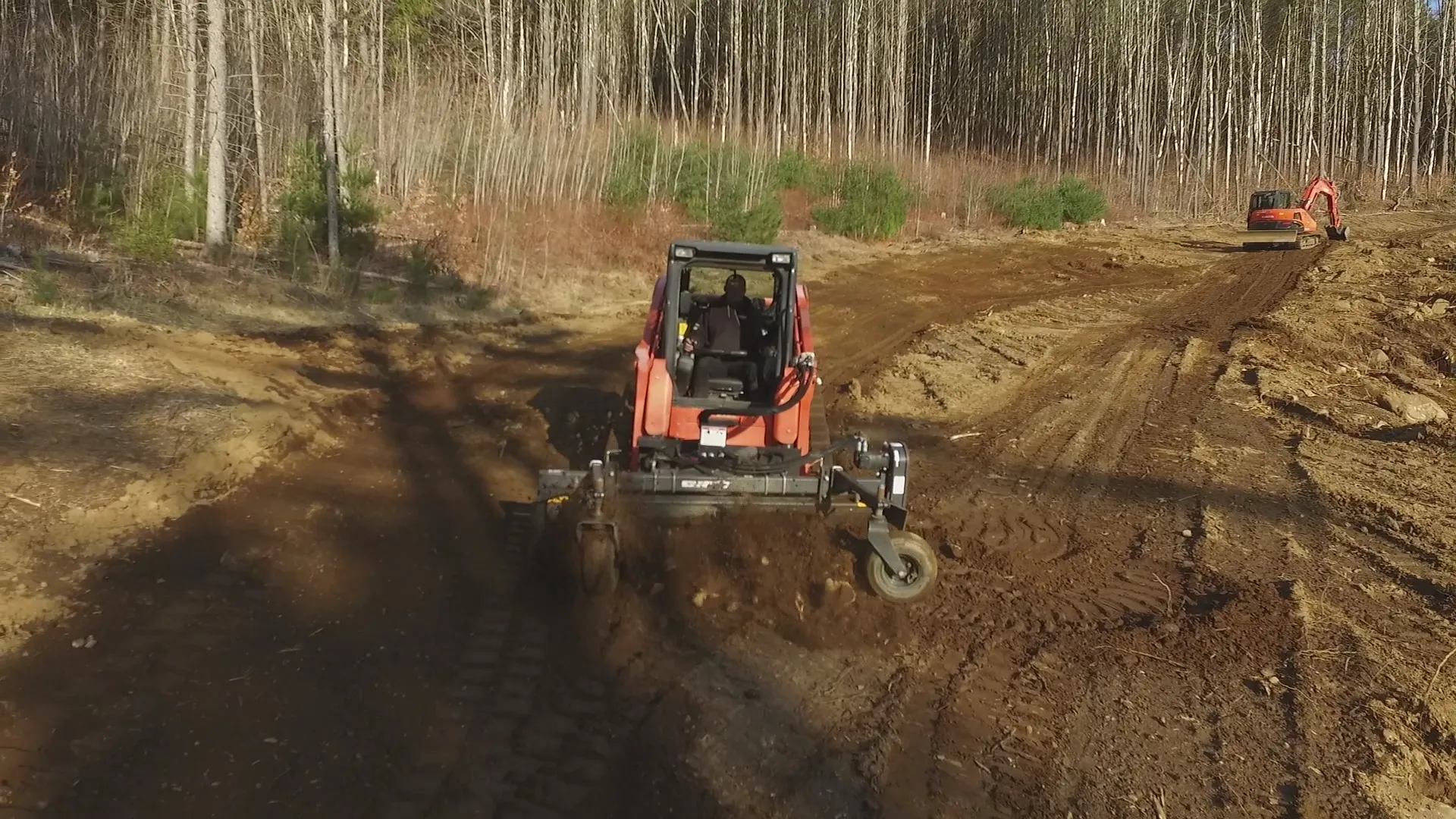
No landscape contractor should be without a powered rake. This multi-functional seedbed and soil surface preparation tool is capable of eliminating compaction and then grading, leveling, shaping and pulverizing various types of soil surfaces to create a near perfect seedbed. If rocks are a problem, a skid-mounted powered rake is also ideal for raking or windrowing rocks and construction site debris. Powered rakes need to be wider than the skid steer so that when angled, they cover the tracks. The roller typically features carbide-tipped studs for long wear life. A powered rake can be angled for wind-rowing or more aggressive pulverizing and most feature gauge wheels. Quality units are bi-directional and have variable speed.Seeders
Smart Box Blades
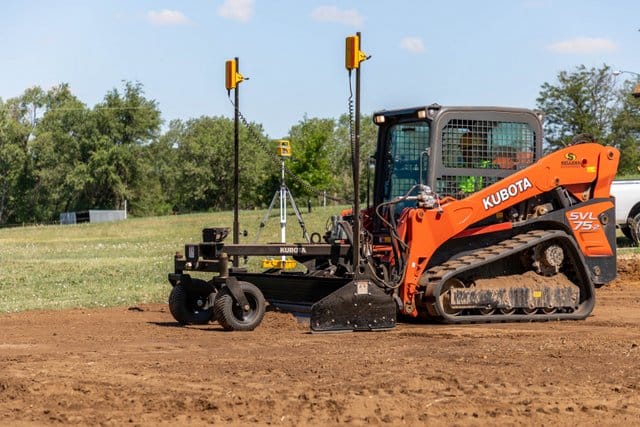
Skid steer and track loader attachments for the landscape industry are too numerous to mention all in full detail. Other, more common attachments include buckets of all shapes and sizes, blades for snow removal or dirt work, augers for building a fence or planting a tree, graders and land planes for leveling sites and refurbishing driveways, rippers to break up and loosen tightly packed soil and grapples in as many varieties as a landscaper can imagine. In fact, when one stands back and assesses the attachment landscape, there is almost a tool for every landscaping need. If there’s not, one will be introduced soon. If we can help you with any of your compact track loader or skid steer attachments, reach out to either of our locations and we'll be happy to talk through the work you want to accomplish and the best attachment options to meet your needs.
To learn more about or Paladin construction attachments, click here.
To learn more about Kubota's compact track loaders, click here.
To learn more about Kubota's skid steers, click here.
Townline Equipment is the leading Kubota dealer with locations in Plainfield, New Hampshire, and Pittsford, Vermont. We sell and service a large variety of equipment including Kubota tractors, Kubota utility vehicles, Kubota zero turn mowers and Kubota construction equipment. If we can be of service, contact us today in Plainfield, New Hampshire at 603-675-6347, or Pittsford, Vermont at 802-483-6464. You can also email us at info@townlineequipment.  The videos and articles on our blog are meant to be a general guide only, so please always consult your owner’s manual for additional detailed product information and related safety precautions. For more information, please visit www./disclaimer .

